An article in the Daily Mail points out that, when it comes to infidelity, it's the woman who gets the worst of it.
In other news, scientists are stunned to discover that fire is hot!
Rabbert blathers on....
Showing posts with label Reality. Show all posts
Showing posts with label Reality. Show all posts
02 January 2010


13 December 2009
When agenda overcomes science
 I'm not too worried about whether or not
But then there are those who step beyond the pale of rationality. For example, Diane Francis, who suggests that the only way to save the earth is to impose a global one-child policy (following China's example) and to enforce it as ruthlessly as China has.
Or the Optimum Population Trust, which wants to sell contraception in developing nations as a carbon offset.
World population is estimated to reach 7 billion by the end of 2011, having increased by 1 billion in just 12 years - all but 4% percent of this increase will be in the less developed countries (LDCs). [... snip...] In short, one less birth into poverty is not only one less person to suffer poverty and the expected severe impacts of climate change, but also one less to produce more greenhouse gases in (hopefully) escaping poverty. (from OPT's FAQ page)
Or the United Nations Population Fund (UNFPA) which, in this year's "State of World Population" report, links population growth to climate change in ways that even they themselves admit are less than direct or immediate.
Although population data are generally regarded as among the success stories of social science, their integration with the developing science of climate change and its human dimensions remains poor. This applies ... to the influence of population growth on greenhouse-gas emissions and climate change adaptation....In other words, the disastrous "influence of population growth on ... climate change" is an assumption for which they have no solid evidence. But they're certain enough to push population control measures on the non-pink and non-rich peoples of the world.
The real solution to our environmental problems - to say nothing of our economic and political problems - is to recognize that we Americans, along with much of the "developed" world, have been taking much more than is just or fair in an insatiable quest for greater comfort and convenience.
We need to curb our "standard of living". Landfills will not grow so fast if we are not basing our egos and economics and desires on the newest or latest or most disposable items. CO2 will not build up so quickly if we don't insist on the cheapest gas and food and electricity on the planet so that we can use it as much as we like without realizing the full cost.
To claim that reducing the population is the solution to our woes is simply to place the blame and burden on those not yet conceived. As a good friend of mine says, "Just enough of me, way too many of you."
Rabbert blathers on....
11 November 2009
Status update
As I mentioned on my other blog, I got in an argument on-line over the past week, and the truth is I've been taking it too much to heart. It's crazy how it just eats away at you, hurt and resentment and fear of being wrong.
But then today I had a job interview, during which the interviewer told me that I basically had the job. It's not a great job, and I'll wait till I actually sign the papers before I throw a party, but it's something. It's better than nothing. Whew!
The good thing is, the job won't necessarily interfere with my writing ambitions. All I need is a little self-discipline!
Heh, pray for me!
Rabbert blathers on....
17 October 2009
On gambling
 My dad loves the casino. He loves the slot machines, which I simply do not understand. For myself, I prefer something more active, something that involves skill and tactics. So, many gambling games just are not interesting to me. Among card games, Pinochle is my favorite.
I do, however, enjoy the occasional game of poker. I like the bluffing aspect. I like the choices involved in building a hand. My favorite poker game, which you'll never find in a casino, is called Chicago: it's basic seven-card stud, but the high spade in the hold splits the pot. It encourages more players to stay in, and throws a wrench in the works of reading other players' bets. Good clean fun -- as long as it's penny-nickel poker among friends.
Some of my friends oppose gambling on principle. And I'll admit that it's an easily addictive activity. I've been in games where I caught myself thinking, If only I put a little more money on the table, I could make back what I lost. But I've also been in control enough to recognize that impulse as a danger sign, a temptation. And I've been able to walk away. Most of the time.
My dad's philosophy, and it's a good one as far as it goes, is to consider gambling an entertainment activity on which you spend some money. First, determine how much you're going to spend on entertainment at the game. That becomes the only money available. You consider the money you bet to belong to the house already; it's spent money. If you win anything at all, that's gravy. If you break even, that's as good as a win.
If someone doesn't bring in more money than they can afford, and doesn't bet more than they bring in, then this system works to make an enjoyable time at betting games. If not, then gambling becomes a real problem and, at that point according to Catholic tradition, a sin.
The truth is, this kind of rule applies to any kind of entertainment activity. Sometimes it's money you're spending, sometimes it's time, sometimes it's physical energy -- usually it's some combination of the three, as for those who love to ski. If you don't overspend to begin with, and you don't let the entertainment overrun its limits, it makes for a good time. If the entertainment gets in the way of the rest of life, then it's a problem, and probably a sin.
For myself, I find the temptation strongest when there's some part of reality that I want to escape from. I use anything from TV to eating to hanging out with friends as ways to escape from difficult tasks or situations. That's a bad habit. That's a vice.
The only way to overcome it is to face reality. Do my duty. Get the job done. And, when it's time to play, play deliberately in a truly enjoyable way.
In other words, let work be work. And when I play poker, play with friends rather than to try to make money; play for the joy of the game, and joy will come whether the money stays or goes.
Rabbert blathers on....
16 October 2009
She's always a woman to me...
 I was raised in a fairly prejudice-free environment -- as much as any environment can be, I suppose. It never occurred to me that different skin color or physical features had anything to do with personality or intelligence or integrity; and it never occurred to me that women and men should be treated differently with regard to authority or dignity. I had to learn about these things in history class.
However, it has always been my instinct, and it remains my reasoned conclusion, that men and women are distinct manifestations of humanity, and therefore should act and be treated differently in respecting those differences. The question is, just what differences are essential to masculinity or femininity, and which are "social constructs" that exalt or oppress or set one sex against the other?
G.K. Chesterton, whom I am currently reading, posits that women and men occupy two distinct spheres of society: the men are specialists whose work and life is based on adherence to rules and whose relationships tend toward the egalitarianism he calls "camaraderie"; meanwhile, women are universalists, adept at everything, whose work and lives is based on the wisdom of an absolute ruler who has influence over every aspect of life within her realm.
That is to say, the sphere of men is narrow, but is free within the whole of public life; the sphere of women is broad, but is free within the limits of the home.
It's an interesting approach. He claims that it respects the freedom and value appropriate to each sex, and I have to say that I approve heartily of his goal. I'm not entirely convinced that his suggested means are the best way to get there. For example, regarding the Suffragettes, he says:
The question is not whether women are good enough for votes: it is whether votes are good enough for women.And he answers that voting takes away the particular dignity of women by imposing on them a public responsibility that (at best) distracts them and (at worst) denegrates them.
Based on his assumptions about the nature of men and women, his conclusion makes some sense. It is exactly those assumptions that I question.
Unfortunately, I don't have an answer of my own ... yet.
I am convinced that one distinctive feature of the sexes is their sexual difference. That is, it is clearly an essential feature of women -- the defining feature, even -- that they are able to bear and nurture children. (Indeed, if it weren't for recombinant DNA, it would be difficult to figure what the defining feature of men could be!)
I'm also convinced that the sexual difference is not the only essential difference between men and women. And this is where things get very muddy very quickly. Some social differences clearly support the sexual differences, such as the tendency in virtually every culture for women to have primary care of rearing children at least until adolescence. Other social differences seem to have little relation to the sexual difference, such as the custom in many places for men to have short hair and women to have long hair.
I suppose my current approach is similar to that of St. Augustine regarding Christian doctrine and practice: "In essentials, unity; in non-essentials, liberty; in all things, charity."
Rabbert blathers on....
11 October 2009
Absurd v. Uncanny
 Just Jen makes a great distinction that the NY Times -- or at least the study they describe -- misses.
On the other hand, how is a scientist to make a distinction that is, perhaps, beyond the ken of science?
What the scientist can study is how the brain acts in certain circumstances. The Times gives the following example:
When ... patterns break down — as when a hiker stumbles across an easy chair sitting deep in the woods, as if dropped from the sky — the brain gropes for something, anything that makes sense. It may retreat to a familiar ritual, like checking equipment. But it may also turn its attention outward, the researchers argue, and notice, say, a pattern in animal tracks that was previously hidden. The urge to find a coherent pattern makes it more likely that the brain will find one.This sort of thing is empirically verifiable. Moreover, various forms of prayer and/or meditation have been shown to correspond to certain brain states. But what is not clear is whether there is an empirical difference between a mystical vision and an experience of absurdity.
In short, can the brain tell the difference between an angelic vision in the woods and a vision of a La-Z-Boy?
The mind certainly can tell the difference. Had Muhammad, or Joseph Smith, claimed to see a talking rocking chair, they would have been laughed out of town. Had Paul told the Athenians that their "unknown god" had raised the Pythagorean theorem from the dead, they would have told him to go study logic.
But these people claimed an experience, not contrary to reason, but beyond reason. They described an event that, if true, would broaden the scope of the world and human experience. This is as true of ghost hunters as it is of prophets. Their experience is uncanny.
The merely absurd, on the other hand, actually attempts to destroy the world and, in particular, human experience. It posits something that disorients, that undermines the trust we put in out senses and intellect. Our minds seek order and rationality in the world; absurdity denies that there is order or rationality to seek.
To which I reply, where did the human mind get the idea to seek order?
In any case, the answer to the question of whether brain states empirically show a difference between an experience of the absurd and an experience of the uncanny would show more about the scope of science than it would about the nature of the universe.
Rabbert blathers on....
27 September 2009
If your hand causes you to sin...
Fr. Daniel, pastor of my parish, made a profound remark in this morning's homily. In the gospel reading from Mark, Jesus admonishes his followers, "If your hand causes you to sin, cut it off; if your eye causes you to sin, pluck it out." Too often I've read commentators or heard preachers attempt to soften the extremity of this advice. After all, we wouldn't want anyone actually maiming or blinding themselves; God couldn't possibly want that! Jesus must have been speaking hyperbolically.
Well, perhaps. But Fr. Daniel pointed out a literal interpretation that brings sharp clarity to our Lord's admonition. "How hard would you fight to keep your hand? Then fight that hard against sin! How firmly would you hold onto your eye? Then cling that firmly to Christ!"
For myself, I too often find myself slipping into sin -- not because I am compelled or coerced, but because it just seems easier or more pleasant. To stay in bed when I need to be awake, to play a game when I have bills to pay, and so on. But if I recognize that it is myself -- my hand, my eye, my very life -- that is at stake, then the path of vice is revealed as in fact harder and more painful, with its destination in death.
And that can be rather motivating.
Rabbert blathers on....
24 September 2009
Commitments
 I find it's difficult to keep a commitment that is too general. For example, it's hard to say, "I'm going to write more" or "I'm going to exercise more". It's easier to keep a concrete, measurable commitment. So, I'm setting a goal of writing at least 500 words every day. (Yes, this blog counts!) It's a small goal, but I know when I've reached it, and it doesn't stop me from doing more; it just keeps me from doing less.
This is part of a larger trend for me. Yesterday, a friend asked me whether I were an optimist or a pessimist. After some thought, I replied that I was an idealist. I tend to think in terms of what should be rather than what actually is. This means that I think and act in ways that sometimes look optimistic (because of the height of my hopes) and sometimes pessimistic (because of the depth of my disappointment). It also means that I tend to pay too little attention to the real world that I in fact live in. I tend to think of goals in terms of "I should write a perfect story or article" rather than "I should write five hundred readable words". Keeping the goals concrete helps keep my feet on the ground. Which is exactly what an idealist like me most needs.
On the other hand, I'm still working on that exercise goal. Right now, I'm thinking a 15-minute walk every day should be do-able. What do you think?
Rabbert blathers on....
21 September 2009
Mark Shea on evil
After all, if there's anyone who would know evil inside-out, it's Mark Shea!
In this case, he makes the point with exceptional clarity:
Rabbert blathers on....
In this case, he makes the point with exceptional clarity:
The Church does not see evil as the "opposite" of good precisely. That's because we are not Manichaeans. We do not believe that evil is a power equal and opposed to good. Rather, we believe that evil is a parasite on the good, a perversion and (mark this) a thing that must always depend on the good in some way for its very existence, while the good exists without needing evil. Because of this, we can always say of any evil that there is *something* of the good about it. Even Satan still retains the good gifts of existence, power, and intellect that his Maker gave him (perverted though they are). To deny this is to deny that God is the absolute Creator of All.This is in the midst of a post on his own attempts to think with Christ and the Church. Worth a read, like most everything he writes.
Rabbert blathers on....
20 September 2009
Historical perspective
In 1943, this was cheering on an ally:
In hindsight, it's rather creepy. To paraphrase the wisdom of others, we should never call someone great before their life is completed.
Rabbert blathers on....
In hindsight, it's rather creepy. To paraphrase the wisdom of others, we should never call someone great before their life is completed.
Rabbert blathers on....
19 September 2009
Larry asks...
 In a comment on my recent health care post, Larry asks:
But what is "society"? In America today, that means tax money. And that's not just politics; it's our culture.Now, I would say that "society" is a somewhat fluid category. I guess I would define society as the subject of solidarity and subsidiarity together.
I trust I make myself obscure.
Really, this discussion brings us back to the whole "common good" question. (Sorry, Amy. But at least I won't quote G.K. Chesterton this time.) It brings us back to the common good because
Solidarity is the recognition that each of us shares much in common with others. It's perhaps something like empathy, but in philosophical terms rather than psychological. (Yes, Larry, I know about the Personalist use of empathy... but bear with me a bit.) So the subject of solidarity is everyone with whom I share something in common. At its broadest, this includes the entire human race: we all share human nature in common. But it can be applied more narrowly as well: I have a particular solidarity with other Catholics, or with other Seattleites, for example, that I don't share with Buddhists or Utahns. I have a very particular solidarity with members of my family, because we share so very much in common.
Subsidiarity is the recognition that each and every individual, and group to whom that individual belongs, has something valuable to contribute to the community. So, the subject of subsidiarity is everyone who makes a contribution to a given community -- that is to say, everyone who is in solidarity with a given community. Again, this can be taken more or less broadly, but the implication is that communities based on a broader solidarity provide broad and foundational support to communities based on a more focused solidarity. Issues that affect the entire nation must be dealt with on a national level, while issues that affect the neighborhood must be dealt with on a neighborhood level.
So, any individual person is a member of multiple communities, multiple societies, ranging from one's nuclear family to the entire human race, with various forms of local, economic, recreational, and political ties in between. And each society has a certain responsibility for its members, based on the kind of solidarity they share.
Now, I'm talking in pretty abstract terms. But I do think it's important to recognize that the "Government" itself has various levels and forms, and these do not entirely encompass the organization of all "society".
In other words, yes Larry, society involves all of culture; no Larry, society does not just mean tax money. But, yes Larry, we Americans tend to think that social responsibilities are carried out through government agencies, so tax money is the first place we think to look. But this need not be the only way to work. After all, various entities of the Church provided medical services for anyone, regardless of creed or ability to pay, for generations -- because they recognized their solidarity with all humanity and took responsibility in whatever concrete way they were able.
Now the Catholic hospitals and clinics are dying, for reasons too complex for a Rodent of Very Little Brain like myself to understand. I don't think that attempting to re-create that network of hospitals is likely to succeed. But I do think that, even if a public health care option is passed through Congress, we need to take direct responsibility for the health of those in our community.
Some of us will take more direct and hands-on responsibility than others, since we all have different gifts and callings; but we all must take responsibility for our own.
Easy to say; hard to do. Let us pray for one another.
Rabbert blathers on....
16 September 2009
Approach the truth with reverence
I'm reading a book by Fr. Benedict Groeschel, CFR which, to be frank, doesn't do a whole lot for me. Mostly a matter of taste. I prefer arguments to allegories, and syllogisms to sentiment. De gustibus non disputandem.
However, in the midst of it he cited this passage from Ven. John Henry Newman:
Moreover, when I have been given a truth, even the truth about my own experience, that is a treasure that I am responsible to use wisely, as a steward. It is a gift that I can and should give to others who need it. I may give different gifts to my close friends (e.g., the truth of my deep experiences) than I give to strangers on the street (e.g., the truth of the time of day) or to partners in a discussion (e.g., the truth of some knowledge or of my perspective), but in every case, I only give what I have received as a gift.
This is rather a new way of looking at things for me. As I mentioned, I have an overly-developed sense of entitlement, and a woefully under-developed sense of gratitude. But, thank God, I do seem to have some capacity to learn.
Indeed, thank you, all of you friends and strangers who have given me the gift of truth throughout my lifetime. I will endeavor to use your gifts well.
Rabbert blathers on....
However, in the midst of it he cited this passage from Ven. John Henry Newman:
For is not this the error, the common and fatal error, of the world, to think itself a judge of Religious Truth without preparation of heart? "I am the good Shepherd, and know My sheep, and am known of Mine." "He goeth before them, and the sheep follow Him, for they know His voice." "The pure in heart shall see God:" "to the meek mysteries are revealed; " "he that is spiritual judgeth all things." "The darkness comprehendeth it not." Gross eyes see not; heavy ears hear not. But in the schools of the world the ways towards Truth are considered high roads open to all men, however disposed, at all times. Truth is to be approached without homage. Every one is considered on a level with his neighbour; or rather the powers of the intellect, acuteness, sagacity, subtlety, and depth, are thought the guides into Truth. Men consider that they have as full a right to discuss religious subjects, as if they were themselves religious. They will enter upon the most sacred points of Faith at the moment, at their pleasure,—if it so happen, in a careless frame of mind, in their hours of recreation, over the wine cup. Is it wonderful that they so frequently end in becoming indifferentists, and conclude that Religious Truth is but a name, that all men are right and all wrong, from witnessing externally the multitude of sects and parties, and from the clear consciousness they possess within, that their own inquiries end in darkness? (University Sermons 10.43)And it struck me just how much I take for granted -- no, really I consider myself entitled to -- understanding the truth about the world and other people and God. Which reminded me of something that Pope Benedict XVI noted in his recent encyclical Caritas in veritate (34):
Truth — which is itself gift, in the same way as charity — is greater than we are, as Saint Augustine teaches. Likewise the truth of ourselves, of our personal conscience, is first of all given to us. In every cognitive process, truth is not something that we produce, it is always found, or better, received. Truth, like love, “is neither planned nor willed, but somehow imposes itself upon human beings”In other words, truth is not something that belongs to me, that I can possess or control, that I can require of the world or of other people. My first attitude toward the truth -- the truth of anything, whether it be science or history or other people -- my first attitude should be humility; and my attitude upon learning anything -- again, anything at all -- should be gratitude.
Moreover, when I have been given a truth, even the truth about my own experience, that is a treasure that I am responsible to use wisely, as a steward. It is a gift that I can and should give to others who need it. I may give different gifts to my close friends (e.g., the truth of my deep experiences) than I give to strangers on the street (e.g., the truth of the time of day) or to partners in a discussion (e.g., the truth of some knowledge or of my perspective), but in every case, I only give what I have received as a gift.
This is rather a new way of looking at things for me. As I mentioned, I have an overly-developed sense of entitlement, and a woefully under-developed sense of gratitude. But, thank God, I do seem to have some capacity to learn.
Indeed, thank you, all of you friends and strangers who have given me the gift of truth throughout my lifetime. I will endeavor to use your gifts well.
Rabbert blathers on....
12 September 2009
Why does anyone get married anymore?
 I am extraordinarily fortunate that my parents are still married to each other. It wasn't easy for them. They both have had second thoughts, and even separated for a time to figure things out. But they realized that divorce would not actually solve any of their problems, and that their best chance at happiness was to work at loving each other better.
On a larger scale, I've noted before that so-called "no-fault" divorce is at the root of many of our social problems with marriage. It seems to me that "no-fault" divorce cheapens marriage to the point of worthlessness. I mean, why take vows "till death" if it really only means "till divorce"?
It seems that at least one other person out there agrees with me. And science bears it out: no-fault divorce does not, in fact, lead to better or happier marriages, or even to happier individuals. At the same time, the National Catholic Register reports on a study showing significant correlation between divorce and certain health issues. (Full article is only available to subscribers.)
This is good for me to see, because I'm always afraid that my idealism is out of touch with reality.
But here's where I get into trouble: I don't see a practical, sure-fire means of correcting this problem. I mean, I can say that what we need is a cultural return to understanding marriage as a lifelong bond. I can talk about the philosophical teleology of man and woman, or about the public and social nature of the marriage covenant. But the fact is that divorce is one of the basic assumptions of our society, almost at the level of being considered a human right. We watch "Kramer vs. Kramer" and wonder what all the controversy was about. And I don't know how to change things on the level of our culture or our society.
But I guess I can offer some suggestions for small changes that might make things better for individual marriages.
1- Remember that a spouse does not exist to make you happy. And vice versa. Marriage is not a toy and is not entertainment. It is a way of giving love, not merely of receiving love.
2- Make your marriage about more than just you two. If marriage is a way of giving love, it's a way of giving love to everyone. Your spouse is the conduit for your love to reach anyone and everyone else around you. Children are the most obvious and natural example of this; but even one's friendships change and shift when one gets married -- because you are not a friend alone, anymore. Friendship includes the spouse.
3- Take time to argue. Seriously. If you are always 100% in full agreement on everything, then something's wrong. Stepford wrong. It's only by discovering where you differ from each other that you'll be open to learning from each other and truly growing closer. It's only by facing conflict that you're able to resolve it.
I'm sure that other people probably have more and better ideas than these, and I know it's horribly dangerous to give unsolicited advice. So please forgive me -- and also correct me! -- if I overstep my bounds.
On the other hand, why should advice columnists have all the fun?
Rabbert blathers on....
09 September 2009
More Chestertonian stuff
I'm reading Chesterton's 1910 classic, What's Wrong with the World. So far, it is (as one expects from Chesterton) a very witty retort to common misconceptions of his age, often turning platitudes on their heads. But also, (as one expects from Chesterton,) many of his points remain just as sharp today as they were a century ago. For example:
In our current culture, it is almost impossible to avoid the Scylla of relativism without falling into the Charybdis of prejudice. That is, either one denies any real difference between one's opponents and oneself, or one judges them to be irrational and arguing in bad faith.
For example, I pointed out to a friend that, while health care of some sort is presented as a basic human right in Catholic social teaching, there is no requirement or expectation that the government will in any direct way provide such care. Rather, the role of the government is to ensure that health care is not denied to any who need it. His immediate response was to call me insane. No reasonable person, he said, could call for universal health care without at the same time making it a government department. In short, he was unable to actually make an argument in favor of government-run health care exactly because he could not accept any argument against it.
I don't know what it would take for our society to discover some other mode of debate besides shouting as loudly as possible, but until we do we will drown in our own increasing irrational prejudices.
Rabbert blathers on....
But the difference between the two mental methods [of dogma and prejudice] is marked and unmistakable. The essential of the difference is this: that prejudices are divergent, whereas creeds are always in collision. Believers bump into each other; whereas bigots keep out of each other's way. A creed is a collective thing, and even its sins are sociable. A prejudice is a private thing, and even its tolerance is misanthropic. So it is with our existing divisions. They keep out of each other's way; the Tory paper and the Radical paper do not answer each other; they ignore each other. Genuine controversy, fair cut and thrust before a common audience, has become in our special epoch very rare. For the sincere controversialist is above all things a good listener. The really burning enthusiast never interrupts; he listens to the enemy's arguments as eagerly as a spy would listen to the enemy's arrangements. But if you attempt an actual argument with a modern paper of opposite politics, you will find that no medium is admitted between violence and evasion. You will have no answer except slanging or silence. A modern editor must not have that eager ear that goes with the honest tongue. He may be deaf and silent; and that is called dignity. Or he may be deaf and noisy; and that is called slashing journalism. In neither case is there any controversy; for the whole object of modern party combatants is to charge out of earshot.
In our current culture, it is almost impossible to avoid the Scylla of relativism without falling into the Charybdis of prejudice. That is, either one denies any real difference between one's opponents and oneself, or one judges them to be irrational and arguing in bad faith.
For example, I pointed out to a friend that, while health care of some sort is presented as a basic human right in Catholic social teaching, there is no requirement or expectation that the government will in any direct way provide such care. Rather, the role of the government is to ensure that health care is not denied to any who need it. His immediate response was to call me insane. No reasonable person, he said, could call for universal health care without at the same time making it a government department. In short, he was unable to actually make an argument in favor of government-run health care exactly because he could not accept any argument against it.
I don't know what it would take for our society to discover some other mode of debate besides shouting as loudly as possible, but until we do we will drown in our own increasing irrational prejudices.
Rabbert blathers on....
Health care myths
An interesting article from the WaPo of a couple weeks back: 5 Myths about Health Care around the World. Here's a quote that caught my eye:
The main problem with the article's proposals is that it would require a complete overhaul of our current medical insurance system. That's something the current administration is dead-set against doing. Strange: you'd think an administration that ran on the slogan of "CHANGE" would be interested in, well, change.
Rabbert blathers on....
The key difference is that foreign health insurance plans exist only to pay people's medical bills, not to make a profit. The United States is the only developed country that lets insurance companies profit from basic health coverage.
The main problem with the article's proposals is that it would require a complete overhaul of our current medical insurance system. That's something the current administration is dead-set against doing. Strange: you'd think an administration that ran on the slogan of "CHANGE" would be interested in, well, change.
Rabbert blathers on....
01 September 2009
Good News report!
In a world where only the most superficial forms of affection seem to get attention, truly heroic acts of love often go unnoticed. But here are a mother and father truly loving their child -- even though he was diagnosed in utero with a fatal genetic defect.
Hat tip to Mark.
Rabbert blathers on....
Hat tip to Mark.
Rabbert blathers on....
Attempting realism
I was having a conversation with a friend about the current health care proposals going through congress. My friend is a devoted member of one of the major parties, and is a lawyer to boot. He's been following politics much of his adult life.
Meanwhile, I have spent most of my life as a political cynic, which was my excuse for remaining ignorant and inactive while reserving the right to snark. Nowadays, though, I've been describing myself as an idealist. The philosophy I have most affinity for is Distributism, but I remain woefully ignorant even of that approach.
My friend's response to my questions and arguments often took the form: "That's just not the way things work! Politics doesn't work that way!" And when I asked why not, he would list a number of causes, such as the need to campaign or the need for groups to express their interests through lobbying, and so on. He would note longstanding practices which have become a foundation for taking political action.
My questions, on the other hand, tended toward the speculative: why are things the way they are? Is there some other way things might be? How can we move toward something better? He would reply that such questions are largely counter-productive, because they don't deal with the world as it actually is right now -- a situation that I am largely ignorant about.
So ... I have been trying to educate myself so that I am not so ignorant. At the same time, I have no attachment to the current American government, nor even to the American form of government. The more I learn about it, the more it either confuses me or frightens me. Sometimes it turns my stomach. And yet, as my friend points out, a complete change of government does not seem to be a realistic option -- and even if it were, what chance is there of a better government taking its place?
The defensive part of me wants to hold strong for philosophy and ideals and justice. I refuse to believe that government, even our government, requires the level of complication and corruption and compromise of principles that appears to be the daily order of business in D.C. and in state capitols and city halls and so on around the country. But am I just being defensive? Am I clinging to a pleasant fantasy? Am I just plain naive?
Rabbert blathers on....
12 August 2009
Thinking about evangelization
 I'm reading a book that's sort of a "how to" on sharing the Gospel in a postmodern cultural setting. Something was bugging me about it, but I couldn't put my finger on it till I talked with my dad about it over some ice cream. (He had chocolate, I had rainbow sherbet.)
Now, my dad has been a salesman for most of his life. He sees everything through the lens of sales. And, as we were talking, he pointed out that the book was describing sales techniques for selling Jesus.
"That's it! You nailed it!" I said. See, people are not objects of sales. Relationships are not commodities that can be exchanged. So, the attitude of sales is just plain wrong for drawing people to a deeper relationship with God.
But then, what exactly is evangelization about? What does Christ mean when he commands his followers to "make disciples of all nations"?
My current thought, well open to revision, is that a "matchmaker" analogy is much more appropriate than a "salesman" analogy. Our task as Christians is to bear witness to Jesus Christ, both who he was historically and who he is now in our individual lives, and to introduce people to him.
This analogy fits very well with our individual-freedom-oriented culture today, but it seems passive compared to the command to "make disciples." Unless it is like saying that a matchmaker has a mandate to "make spouses of all peoples." Still thinking thoughts about it.
Rabbert blathers on....
04 August 2009
In case you wanted to know...
I'm pretty sure that this is the text of the much-talked-about "Obama health care plan." The official title is H.R. 3200. In case you wanted to know what it actually, you know, said.
It's also available in .pdf format.
Rabbert blathers on....
It's also available in .pdf format.
Rabbert blathers on....
27 July 2009
No Bright Line on the Horizon
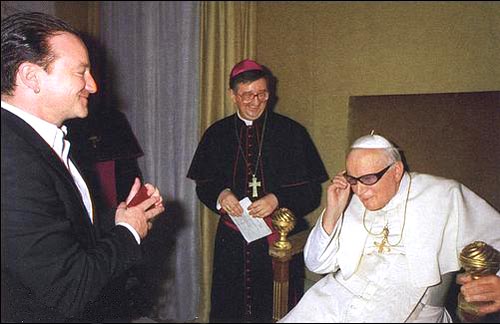 I've been having a conversation on Facebook about the difference between the cardinal virtues (prudence, justice, fortitude, and temperance) and the theological virtues (faith, hope, and love); and also talking to lots of people about health care (both on-line and off), and in both cases I've found people looking for a bright line dividing one thing from another. With virtue, it's a line separating nature from grace. With health care, it's a line separating "basic" health care from "extraordinary" care. I've seen the same kind of search for bright lines in defining torture, the status of a fetus, the viability of a terminally ill patient, environmental impact, and so on.
But I'm not sure if such lines really exist. Or, at least, I'm not sure that looking for such lines really help us out. After all, whenever we try to define something too strictly, we can always find exceptions, or we look at "hard cases", or we just plain find that strict lines or rules force us away from our own everyday lived experience.
I'm not trying to do away with definitions -- far from it! I'm simply saying that the more our definitions try to attain abstract mathematical perfection, the more they will depart from the reality of the world. Instead of trying to fit the world into our definitions, I think we need to fit our definitions to the world as it actually is.
I don't have a perfect answer for how to do that. In fact, I'm hoping that some readers out there will have some good ideas to contribute. But I'd suggest, as a starting point, a recognition that every thing and every event and every person in all of God's creation is absolutely and utterly unique; there never has been, nor ever will be, the same thing or event or person again. At the same time, every thing and event and person is truly and deeply related to every other -- some more closely, as family members, and some more distantly, as a butterfly's flight in China affects the weather in Bolivia. Searching out the ways in which a thing is unique, and also the ways in which a thing is connected and related to other things, I hope, will bring us closer to understanding the world around us.
Clear as mud? Any thoughts or ideas?
Rabbert blathers on....
Subscribe to:
Posts (Atom)


 Posts

